 SURVIVAL APPS
72-Hour Emergency Kit: What to Pack and How to Prepare
Three days without power, network or open shops: what to keep ready, how to organise it, and where the 72-hour rule comes from. It is not an alarm: it is preparation that takes an afternoon and also helps with an ordinary blackout.
- 72 hours is the minimum the European Commission points to (non-binding guidelines, 3 November 2026) for getting by on what you have at home.
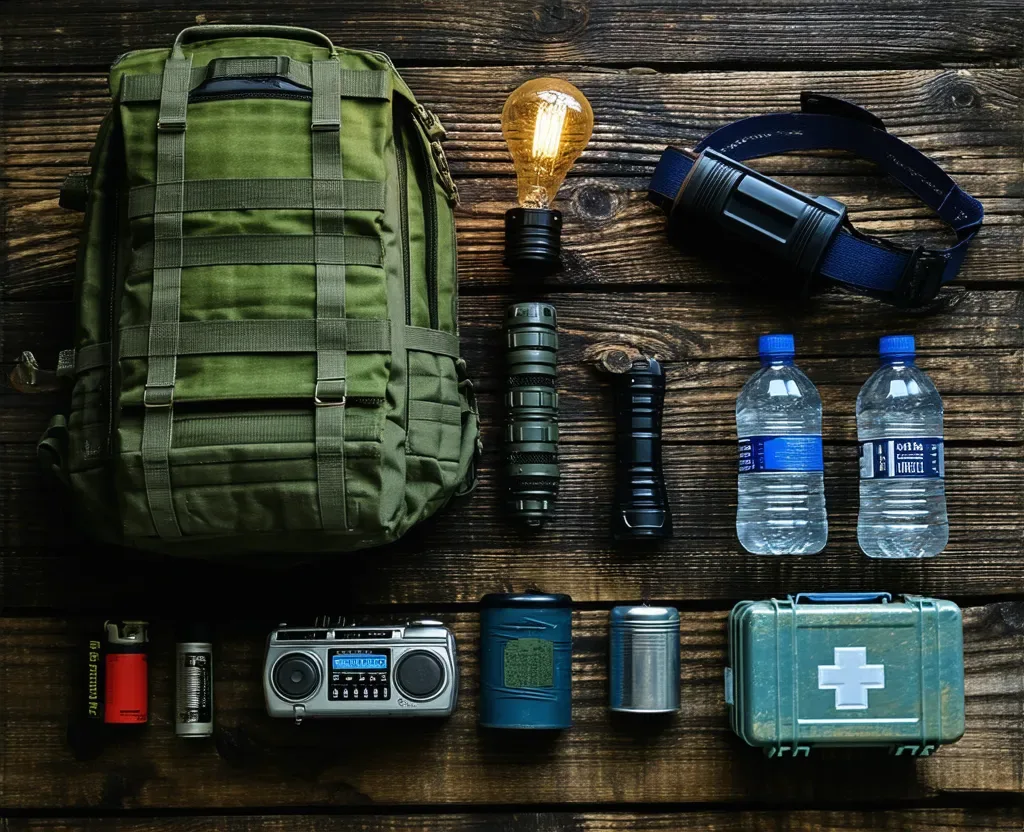
- The kit covers six things: water, food, warmth and light, hygiene, medicine, information and communication. Plus documents and cash.
- Everything in one place, and test it once: switch on the torch, listen to the radio, check the batteries.
- The plan matters as much as the items: a meeting point and the important phone numbers written on paper.
What to put in a 72-hour kit: the list
The European Commission starts from six basics: the list follows the same order.
- 1. Water — for drinking you need at least 1 litre per person per day (the 2012 handbook threshold): 3 litres each in 72 hours. Cooking and hygiene take much more: Item90 estimates 3 litres per person per day, about 9 over three days. Keep purification tablets and follow the instructions on the pack. The Commission gives no quantity.
- 2. Food — stored at room temperature and eaten without cooking or with little water: bars, nuts, tinned food. Add a tin opener and disposable cutlery.
- 3. Warmth and light — a torch with spare batteries (a head torch is better, it leaves your hands free); a blanket or sleeping bag in winter; in summer, sheets to shade the windows.
- 4. Hygiene and toilet — wipes, soap, toilet paper, rubbish bags. Think also about the toilet without water: a bucket or jerry can and strong bags are enough.
- 5. Medicine — the medicines you take, with a copy of the prescriptions, and a first aid kit. Check the expiry dates and, if you use electrical medical devices, ask your doctor or local health service what to do if the power fails.
- 6. Information and communication — a battery radio (Italian Civil Protection recommends one that works without mains power, because in an emergency it favours radio and television) and a charged power bank, with its cable.
- Also: documents — copies of the most important ones in a waterproof pouch, and a list with your family's details, phone numbers and basic health information (blood group, allergies, medicines).
- Also: cash — in small notes and a few coins: if electronic payments fail, you need it.
- Also: clothing — one change per person, a waterproof windproof jacket, sturdy shoes.
- Also: minimal gear — matches or a lighter (not for lighting or heating indoors), a knife, tape, nylon bags, copies of your house and car keys, paper and pen.
Write the list, keep it where everyone can see it, and check from time to time that everything is there and works: flat batteries and expired medicines are the most common problems. To choose radio, power bank and torch: the minimum physical kit.
Home supplies vs emergency bag: the difference
They are two different things and it is worth keeping them apart, as the Commission itself asks. Home supplies are for when you stay where you are: blackout, bad weather, a long outage. The emergency bag (the grab-and-go bag) is for when you must leave home quickly: earthquake, flood, evacuation. The first is a stock in a cupboard; the second sits near the door and can be picked up in a minute. The list below is for home supplies, and its essential items (documents, cash, medicines, light, water) also go into the bag.
The family plan
Objects are of little use without a plan. The Commission points to two things to have clear: where the nearest shelter is and how to find family and friends if the mobile network is down. In practice:
- A meeting point — one near home and one farther away, agreed with everyone.
- Numbers on paper — if the phone is flat you will not remember numbers by heart.
- Who needs help — the elderly, children, anyone who takes medicines or uses electrical medical devices: who looks after whom.
- Neighbours — preparedness works better shared: know who has a radio, a camping stove, a car.
- The municipal plan — on your municipality's website you will find risk areas, safe zones and evacuation routes.
What the European Commission decided on 3 November 2026
- 72 hours as a minimum level — the Commission puts more weight on taking the first steps than on the number of hours.
- Six basics — water, food, warmth, hygiene, medicine, information and communication.
- For every disruption — useful both for a serious crisis and for more common interruptions, such as a power outage.
- Supplies and bag are two different things — the first is for staying put, the second for leaving quickly.
- No fixed quantities — the 72-hour document sets no amounts, not even for water.
Variants: families, pets, earthquake, blackout, flood, heat
Families with children
Multiply water and food by the number of people, then add what they need: milk or baby food, nappies, an extra change of clothes, a toy or a book to keep them calm. The handbook suggests one bag per family member.
Pets
Food and water for three days, lead or carrier, health booklet, any medicines. If you have to leave home, work out beforehand where you can take them: not all shelters accept them.
Earthquake
The bag stays near the exit, with sturdy shoes by the bed and a meeting point agreed with the family. The handbook reminds you to carry the list of family members and their health details.
Blackout
Here you stay home, so light, radio, power bank and food that needs no cooking matter. Battery light, never candles; no gas stoves, barbecues or generators indoors: carbon monoxide is invisible. For the same reason, no gas or kerosene heaters burning in closed rooms. You eat cold. The history of cyber attacks, from the 1988 worm to supermarket fridges, and what to do at home are in transmission 041.
Flood and bad weather
The bag must be quick to grab and carry to the upper floors or out of the house: documents in a waterproof pouch, closed shoes, a waterproof jacket. Do not go down to garages or basements, do not use the car, and stay away from underpasses, embankments and bridges. Find out in advance, on your municipality's website, about risk areas and the safe zones in the civil protection plan. What the alert colours mean: yellow, orange and red.
Extreme heat
Water goes to the top of the list: keep more than the minimum and drink regularly, even more if there are elderly people or children at home. Add a thermometer, curtains or sheets to shade the windows, and a plan for the hottest hours. If confusion, hot dry skin or fainting appear, call the emergency number (112). Among the tools below, HotSummer turns temperature and humidity into guidance for the next hour.
How to stay informed and communicate when the network fails
If cell towers are overloaded or down, the phone becomes a torch with a draining battery. Practical alternatives, and their limits:
- Battery radio — receive only, but one of the channels Civil Protection favours in an emergency, together with television.
- IT-alert — Italy's national public warning system sends messages to the phones in an area through the mobile network cells. Receive only, it does not work if the network is down and it does not cover every risk: the status for each risk changes over time, so check the official site (in Italian).
- PMR446 — licence-free portable radios for short-range communication, useful in the family or the building. In a city the range is often a few hundred metres.
- Meshtastic / LoRa — text messages between devices on mesh networks, with no cell towers. It needs dedicated devices and some practice before you trust it: I write about it in transmissions 018 and 029.
Maps that work without a network are in transmission 037; what your phone can already do in an emergency, in 034.
Test your kit in half an hour
A kit you never tested is a gamble. One evening, try not using the sockets and the network at home: switch on the torch, listen to the radio, check that the power bank charges the phone, open a tin with the tin opener. In half an hour you find out what is missing (often the batteries). It is also one of the practical skills the Commission mentions: knowing how to cook without electricity.
Printable checklist
Print the page or copy the list and tick items off as you go.
- ☐ Water: 3 litres each to drink, plus a reserve for cooking and hygiene
- ☐ Food that needs no cooking, with a tin opener
- ☐ Head torch and spare batteries
- ☐ Blanket or sleeping bag
- ☐ Wipes, soap, toilet paper, rubbish bags
- ☐ Medicines, copy of prescriptions, first aid
- ☐ Battery radio
- ☐ Charged power bank and cable
- ☐ Copies of documents and a list of family members
- ☐ Cash in small notes
- ☐ A change of clothes, waterproof jacket, sturdy shoes
- ☐ Matches or a lighter, knife, tape, bags
- ☐ Important phone numbers written on paper
- ☐ Meeting point agreed with the family
Survival Apps tools
They are apps you buy once, with no subscription. None replaces a physical kit: they help you keep your supplies in order and stay informed. Here is what works offline.
- Item90 — your home supplies room by room, with needs by people and days and an expiry radar. After activation it is used offline: the network is needed to verify the licence at activation and, now and then, afterwards. How it came about.
- HotSummer — heat risk index and recommended time window: to compute them it needs weather data, so a network. The Remedies tab opens even without a connection.
- BioRadar — flora and fauna scanner; the archive of eight biomes can be browsed offline, while scanning with iNaturalist community data needs a connection.
- EcoSurvivor — personal finance: data stays on the phone and the app works offline. Useful for keeping track of how much you put aside, cash included.
Try them first. After buying, open the app once with a connection, then switch on airplane mode and check that the tabs you need open. For your supplies, also keep a paper copy of the list: if the phone will not start, the list is still there. Better to find a problem today than during a blackout.
Frequently asked questions
What goes in a 72-hour kit?
Water, food that needs no cooking, a head torch, a battery radio, a power bank, medicines, hygiene items, documents and cash. The full list is above.
How much water do I need for 72 hours?
For drinking, at least 1 litre per person per day: 3 litres each in 72 hours (Italian Civil Protection handbook). Cooking and washing take much more: the Item90 estimate is 3 litres per day, about 9 over three days. The European Commission gives no quantity. In the heat, or with children or the elderly, keep more.
Is a 72-hour kit mandatory?
No. The European Commission guidelines of 3 November 2026 are non-binding: they offer a goal to Member States and citizens without imposing it.
What is the difference between an emergency kit and an emergency bag?
Home supplies are for staying at home during a disruption; the emergency bag (grab-and-go bag) is for leaving home quickly. The Commission asks that they be kept distinct. Some items (documents, cash, medicines, light) go in both.
Why 72 hours and not a week?
Because, according to the Commission, they are the most critical hours: emergency services are under heavy pressure and for people these are hours of uncertainty. Three days is an internationally recognised minimum standard. If you can, keep more.
What do I need for a blackout?
Battery light (not candles), a battery radio, a power bank, food that needs no cooking, water, cash and a blanket. No gas stoves, barbecues or generators indoors, because of carbon monoxide.
Which official guidance applies in Italy?
Italian Civil Protection guidance applies: Io non rischio, the flood leaflet and the 2012 handbook, cited above. The European guidelines of 3 November 2026 are non-binding. Where you live, your municipal plan applies.
Where do I find official guidance for my area?
On your municipality's website, in the municipal civil protection plan, which lists risk areas, safe zones and evacuation routes. The single emergency number across the EU is 112.
Sources
- European Commission, DG ECHO, Commission takes new steps to prepare Europeans for growing crisis risks (3 November 2026)
- European Commission, Reaching a Population Self Sufficiency of at least 72 Hours, SWD(2026) 826 final, Brussels, 30 October 2026
- European Commission, Guidelines on Population Preparedness, C(2026) 8250 final
- European Commission, EU Preparedness Union Strategy (press release, 26 March 2025)
- Italian Civil Protection Department, leaflet In the event of flooding (undated)
- Io non rischio, Prepare section (in Italian, undated)
- Italian Civil Protection Department, IT-alert (in Italian)
- Italian Civil Protection Department, La Protezione Civile in famiglia (handbook, 2012, in Italian)
A living page: I rewrite it when the guidance changes or when a field test proves me wrong. May your code survive the apocalypse, and may your bag already be packed.