 SURVIVAL APPS
Meshtastic: the network that doesn't need the internet to exist
In the first note on the cyberdeck I left a line hanging: "ready for long-range, low-power off-grid communications, to be covered in a dedicated episode". This is that episode. Before I solder a single pin, I want to understand — and help you understand — what I'm actually about to stuff inside the case.
What Meshtastic is
Meshtastic[1] is open source firmware that turns a cheap microcontroller with a LoRa[2] radio chip into a node of a mesh network for messaging and location. No SIM, no cell tower, no router: each node talks to the ones within radio range and, when needed, relays other nodes' messages all the way to their destination. It's the same principle as a relay of runners, applied to data packets instead of letters.
It's not a replacement for the internet: bandwidth is minimal (built for short text, GPS position, telemetry), not for streaming or browsing. It's a communication layer that stays standing when the others fall — the very definition of "grid-down" that drives the whole cyberdeck project.
How it works, in practice
- RANGE — from a few hundred meters in a city (obstacles, buildings) to several kilometers in open country or between two hilltops, thanks to LoRa modulation, designed for long range at very low power
- MULTI-HOP MESH — a message that can't reach its destination directly gets repeated by intermediate nodes: the more nodes you add to the network, the more the overall coverage grows
- MINIMAL POWER DRAW — a node listening draws milliwatts: it runs for days on a smartphone battery, months with even a small solar panel
- ENCRYPTION — messages on the channels are encrypted (AES-256 by default on the primary channel); no plaintext amateur radio, for those worried about casual eavesdropping
- NO INFRASTRUCTURE — no subscription, no central server to keep alive: the network exists as long as the nodes that make it up exist
- COMPANION APP — an app (Android/iOS/web) over Bluetooth shows the map, messages and node status; the node works fine even with no phone connected
Three flagship hardware nodes
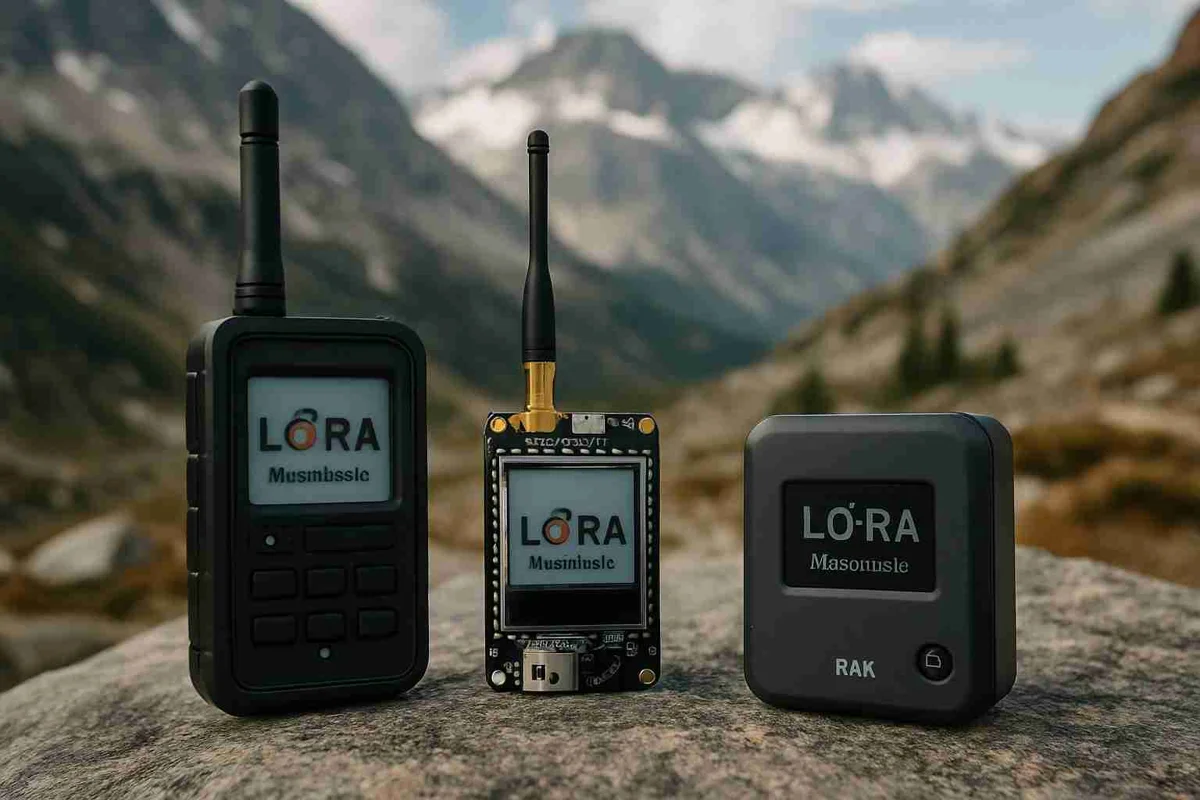
The beauty of Meshtastic is that it runs on boards costing a few tens of euros. Three reference points, for three different needs:
- HELTEC WIFI LORA 32 (V3) — the most common ESP32-S3 + SX1262 board for getting started: cheap, well documented, the natural entry point for a first bench node. Product page — Heltec Automation
- LILYGO T-DECK — a real handheld communicator: screen, compact physical keyboard and LoRa in a single pocket-sized body, made for messaging without pulling out your phone. Product page — LILYGO
- RAK WISBLOCK (RAK4631) — an ultra-low-power modular platform, the most solid choice for a fixed solar-powered node: you only add the modules you need. Product page — RAKwireless
> firmware: meshtastic
> band: EU868 (verify on site)
> listening power draw: ~mW
> status: UNDER EVALUATION FOR FIELD CYBERDECK
Frequently asked questions
Is Meshtastic only useful in extreme scenarios?
No. It's also used for hiking, backcountry skiing, events with no cell coverage, construction sites, sailboats: any situation where your phone has no signal but you still need to coordinate.
How many nodes do I need for a useful network?
Even just two, to talk to each other without a cellular network. The value of the mesh grows with the number of nodes: a handful scattered across a valley or a neighborhood extends coverage well beyond the range of a single device.
Is it legal to use freely?
Yes, on the free bands allowed in your region (868 MHz in Europe, 915 MHz in the USA) and within local power limits: same regulatory category as a LoRaWAN doorbell, no ham radio license needed for basic use.
Is Meshtastic connected to other projects on this blog?
It's the candidate radio module for the field cyberdeck under construction: long-range, low-power off-grid communications for the same machine built for scenarios with no power grid and no internet.
The radio module for the cyberdeck finally has a name and three candidate boards on the bench. The next episode in the series will tell you which one I picked — and why. May your signal survive the apocalypse.
Notes
- Meshtastic — open source firmware project (GPL) born in 2020, today among the most widely used for amateur and community LoRa mesh networks. ↑ back to text
- LoRa (Long Range) — a spread-spectrum radio modulation from Semtech, designed to transmit small amounts of data over long distances with minimal power draw: the physical foundation both LoRaWAN and Meshtastic run on. ↑ back to text
- EUROPE & UK —
EU_868(868 MHz) - USA & CANADA —
US(915 MHz) - AUSTRALIA —
ANZ(915 MHz) - NEW ZEALAND —
NZ_865(865 MHz)