 SURVIVAL APPS
War Zones — the world's conflicts, read by someone who builds
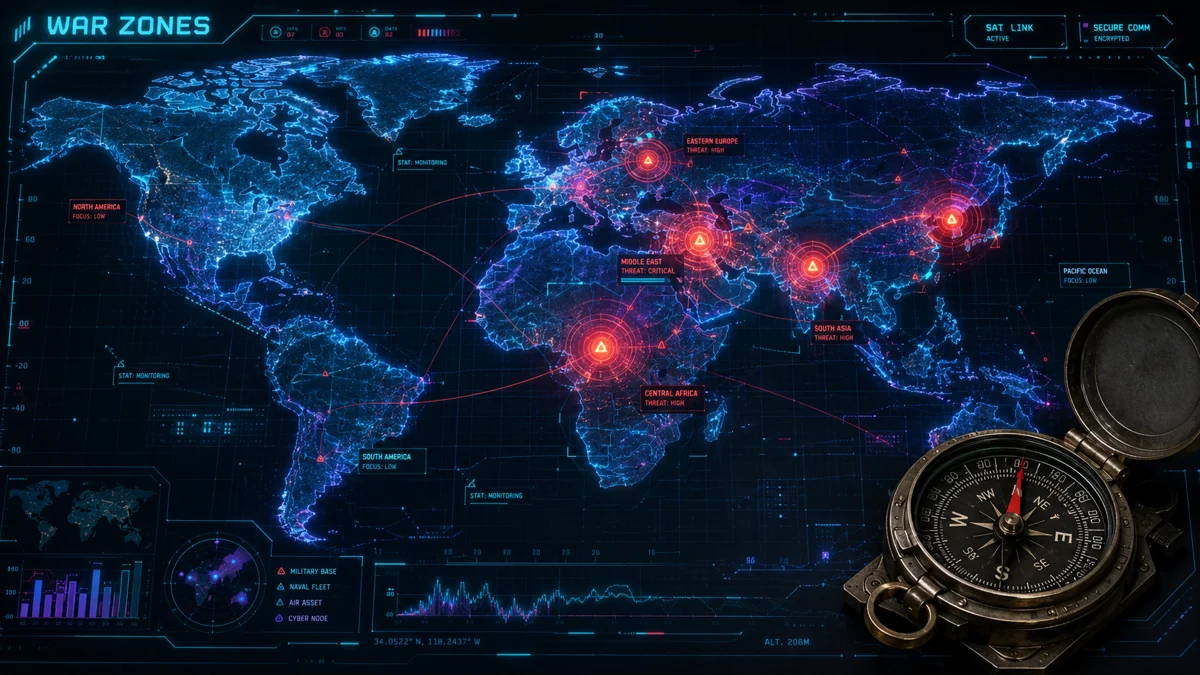
Among the ruins you learn one thing fast: every pile of rubble has a before. A building, a plant, a network that used to work. I spend my time putting back together pieces that someone, somewhere, decided to break. It's not a job that makes you optimistic by default. But it teaches you to recognize, at a glance, the difference between whoever built a piece and whoever destroyed it.
How many conflicts are there in the world today
The most-cited estimates put it at over 50 active conflicts in the world right now — not all of them declared wars, many of them low-intensity conflicts, insurgencies, proxy wars[1]. Most of them never make our news headlines: these are the forgotten conflicts, the ones people only talk about when they touch interests close to home. That doesn't make them any less real for the people living inside them.
This isn't a number meant to scare you. It's a number to calibrate your compass: the world has never been "at peace" in any absolute sense, and it helps to know that instead of finding out all of a sudden when a conflict stops being far away. If you want to see the up-to-date picture, instead of trusting the selective memory of the news, you can go straight to the ACLED Conflict Index: data collected on the ground, continuously updated, with no editorial filter.
The superpowers: USA, Russia, China
Three different powers, three different ways of projecting force — and three reasons to look at them without picking a side, just to understand the board everything else moves on.
- UNITED STATES — the biggest industrial-military machine ever built, backed by a technological and financial apparatus that nobody else replicates at the same scale. It projects power everywhere, often without even having to use it: deterrence[2] is already a result.
- RUSSIA — strategic depth and a nuclear arsenal that remain unmatched in geographic reach and staying power. A power that plays the long game and bets on resilience, more than on speed.
- CHINA — the fastest industrial and infrastructure growth in recent history: not just armies, but ports, railways, digital networks built at a speed the West struggles to even conceive of.
Three enormous powers, capable — if they wanted to — of hurting the whole world in a few hours. And that's exactly why the way they choose to use that force matters more than any flag.
> active superpowers: 3
> combined destructive capacity: ENOUGH TO END EVERYTHING
> recommended option: build
Building vs destroying: the choice that really matters
I've spent years salvaging hardware from scrap, getting machines back on their feet that someone had thrown away, turning ruins into useful tools. From this perspective the difference between a builder and a destroyer isn't ideological: it's practical. Whoever destroys leaves behind a problem that someone else will have to solve, often at a far higher cost than it took to destroy. Whoever builds leaves one problem fewer for the world that comes after.
The superpowers are no exception. They have the technical ability to build anything: infrastructure, networks, healthcare, shared knowledge. They also have the ability to wipe all of it out in an afternoon. The question isn't whether they can do it — they can, all three. The question is what they choose to do with that ability, every single day.
Let's try to get along: it would be stupid to destroy ourselves.
It's not a naive observation. It's math applied to survival: in a world where three players together have the ability to make entire regions of the planet uninhabitable, mutual self-destruction isn't an abstract tragedy — it's an operational risk. And anyone who works among the ruins knows something you can't see from charts and press releases: rebuilding always costs more than destroying did. Always.
Frequently asked questions
What are the conflicts in the world today?
Dozens of active conflicts coexist right now, from conventional wars to insurgencies and proxy wars. Up-to-date maps of the world's conflicts change constantly: what matters, more than the exact number, is that no region is ever truly safe from escalation.
How many conflicts are there in the world right now?
The most-cited independent estimates put it at over 50 active conflicts globally, counting low-intensity ones and those that don't make the news.
Why do we always talk about the same superpowers (USA, Russia, China)?
Because they're the only three players with enough industrial, military and technological capacity to directly influence the global balance, not just regional ones. It's not a value judgment: it's a matter of scale.
What do you really need to survive in case of war?
Fewer gadgets and more method: water, independent power, communications that don't depend on a single infrastructure — like a Meshtastic network that doesn't go through the cell network — and the ability to rebuild with what's left. It's the same approach behind every project on this blog.
The construct, when I asked it what it thought of all this, didn't answer in words. It just left an ancient log open for a moment: coordinates of cities that no longer exist on any modern map. Then it closed it again. I didn't push.
May your code survive the apocalypse.
Notes
- Proxy war — a conflict in which two (or more) powers confront each other indirectly, by funding, arming or training local factions instead of clashing head-on. Less direct risk for whoever fights it from afar, same cost in lives for those fighting it on the ground. ↑ back to text
- Deterrence — a strategy that aims to prevent an attack by making retaliation certain and unbearable for whoever launches it: you don't fight the war, you make it too costly to be rational. ↑ back to text