 SURVIVAL APPS
HotSummer, from concept to code
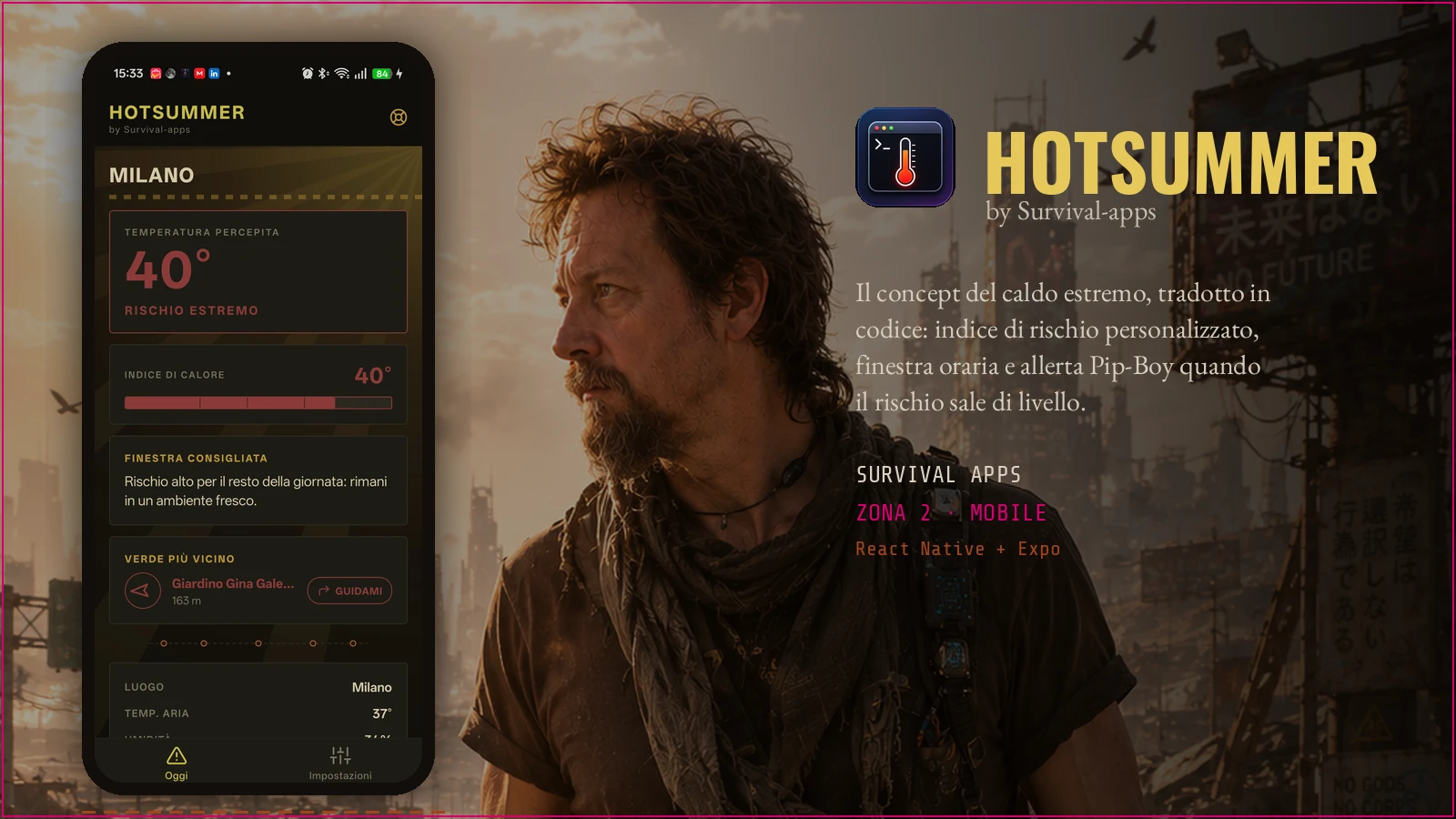
The construct's fans spin up an hour before I realize it's too hot to think — I wrote that in transmission 017. Nine days later, the concept stopped being just a log read by metal: it's code running on a real phone.
From paper to product
The previous transmission was a concept: not a single line of code, just the problem — heat alerts stay at a level too generic ("red alert") to tell a real person what to do in the next hour. HotSummer started as a prototype — React Native with Expo Router, no backend, everything client-side — and went from a summer's field test to the actual catalog: it's on sale for 7.99 €, same price and same lifetime-license philosophy as BioRadar and EcoSurvivor. The technical parts list I promised back then doesn't just exist now: it's what runs on the phone of whoever buys it.
What it does, today
- PERSONALIZED RISK INDEX — feels-like temperature (Open-Meteo) across 4 levels, raised by the optional user profile (age, weight/height, outdoor activity, health conditions): the more vulnerability factors, the sooner the alert fires.
- RECOMMENDED TIME WINDOW — "you can stay outside until HH:MM", not a generic bulletin you have to interpret.
- LEVEL-JUMP ALERT — when the risk gets worse: a notification, a three-tone chirp generated with ffmpeg, and an amber Pip-Boy style pop-up (phosphor CRT, scanlines, flicker) with precautions tuned to the level. It only fires on the way up, never on first launch.
- NEAREST GREEN — a card always on the Home screen with the nearest park/woods, an arrow oriented by the device's compass, and a "GUIDE ME" button that opens Google Maps. Data from Overpass API (OpenStreetMap), with a local stale-while-revalidate cache: if the network goes down it still shows the last known result.
- THREE WAYS TO PICK THE PLACE — GPS position, search by name, or a point chosen on an embedded Leaflet map (for a place you're not at yet, like tomorrow's job site).
- REMEDIES — a static card that's always within reach: heat stroke warning signs, what to do right away, when to call emergency services (112 in the EU, 911 in the US and Canada, 999 in the UK, 000 in Australia, 111 in New Zealand). It's not medical advice.
> stack: Expo Router, Open-Meteo, Overpass API — zero backend, zero API key
> status: AVAILABLE — 7.99€, lifetime license, on Payhip
Zero backend, zero secrets
Same matter of principle as other projects in this folder: no server of my own to maintain. Weather and geocoding come from Open-Meteo (free, no key); the nearest park comes from OpenStreetMap's Overpass API, queried across 4 public mirrors in a parallel race — the first to answer wins. The map for picking a point uses Leaflet embedded in the bundle and OpenStreetMap tiles, not Google Maps: no API key to manage there either.
Frequently asked questions
Is HotSummer available to download yet?
Yes: it's on sale for 7.99 €, lifetime license, no subscription — same model as BioRadar and EcoSurvivor. All the details, the screenshots and the purchase link are on the dedicated product page.
What's different from the concept in transmission 017?
The concept floated a PWA or Capacitor; the product is native React Native/Expo, and every feature imagined back then (risk index, time window, hydration reminders) already exists, plus two I hadn't planned: the level-jump alert with the Pip-Boy pop-up and the "nearest green" card.
Why no background notifications for now?
On Android, background fetch is throttled and poorly guaranteed; I deliberately dropped it for this phase, until I work out whether the extra complexity is worth it.
A written concept is already something. A concept running on a real phone, with the compass pointing at the nearest woods, is the next step. May your code survive the apocalypse — and a 45-degree summer.