 SURVIVAL APPS
Field cyberdeck: concept and parts list for a grid-down scenario
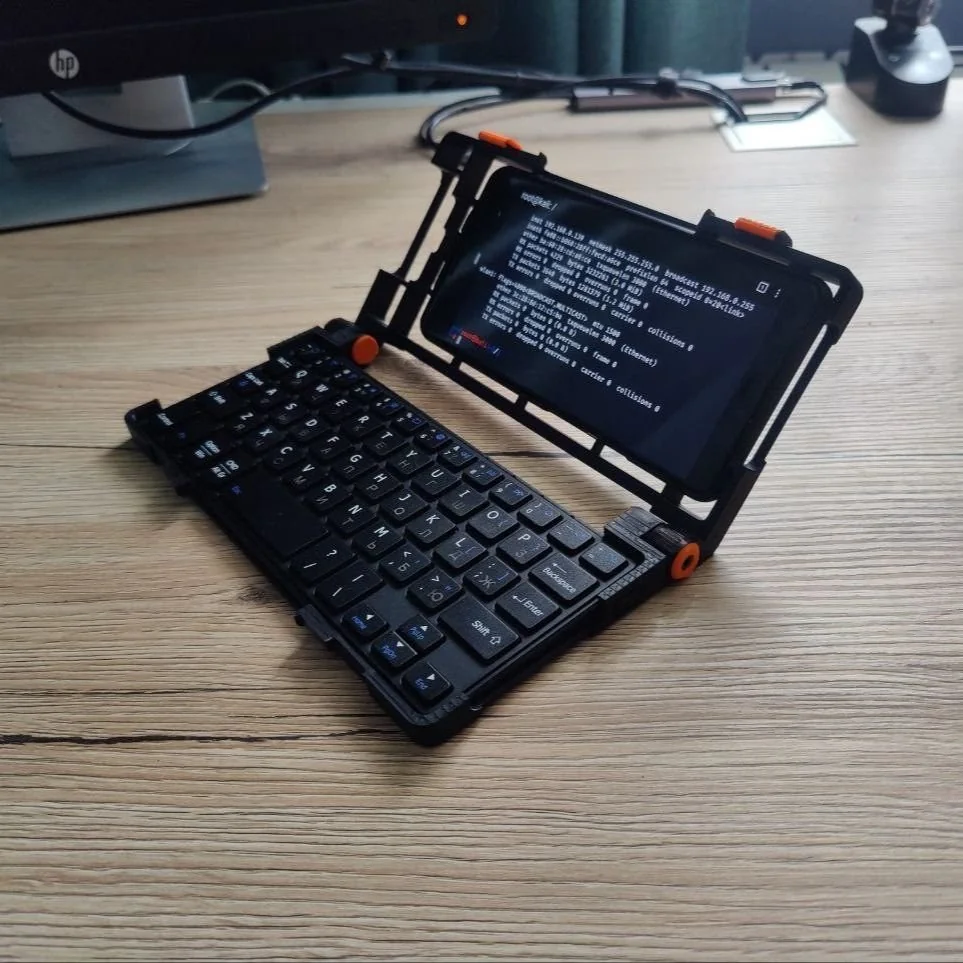
Every workshop should have one machine ready to leave the workshop. Not the most powerful: the most stubborn. The one that powers on when the electrical grid is a memory and the last antenna has stopped answering. This field note is the first in a series: I'm building that machine.
What a cyberdeck is (and what I mean by it)
The term comes from William Gibson's novels[1], but the community that builds cyberdecks today[2] has given it a practical meaning: a hand-assembled portable computer, often built around a single-board computer, with aesthetics and priorities set by whoever builds it instead of by a marketing department. Some people build them for looks, some for retrocomputing. Mine has a stated goal: to be useful in a grid-down scenario — no power grid, no internet.
Every design constraint follows from that goal, in order of priority: energy autonomy (it has to live off rechargeable batteries topped up by a solar panel), knowledge on board (it has to be useful even with no connection at all), repairability (standard, replaceable parts, no glue where screws will do) and, last by choice, computing power.
The parts list, with reasons
- BRAIN: RASPBERRY PI — a single-board computer from the Pi family: consumption in the range of a few watts, 5 V power, GPIO for future expansions and a mountain of documentation. A refurbished used laptop stays on the table as plan B, but it loses on power draw and modularity
- POWER: 18650 CELLS — a battery pack built from 18650 cells[3] with a dedicated protection/charging circuit: a hugely widespread standard, cells replaceable one by one, rechargeable from a solar panel through a charge controller
- DISPLAY: 7 INCHES — the compromise between terminal readability and power draw: a big panel is the single hungriest component in the whole machine
- COMPACT MECHANICAL KEYBOARD — reduced layout (60-65%), swappable switches: it's the primary interface and it has to survive years of use and the odd repair
- SHELL: HARD CASE — a watertight technical case: protection, portability, and the internal layout stays reconfigurable
- RADIO: LORA/MESHTASTIC MODULE — provision for long-range, low-power off-grid communication; it will get its own installment
Knowledge on board
A field computer with no internet is worth exactly what it contains. The software plan is an offline archive: Kiwix with ZIM files[4] of Wikipedia and a few technical wikis, PDF manuals, downloaded maps of my own region, and the documentation for the languages I work in. The whole library fits comfortably on an SD card of a few dozen gigabytes — which, if you stop to think about it, is still one of the things closest to magic that the old world left us.
> brain (pi + sd): ~3-5 W under load
> display 7": ~4-6 W at medium brightness
> lora radio: negligible (mW, listening)
> target runtime: ONE WORKDAY ON ONE 18650 PACK
Frequently asked questions
What is a cyberdeck?
A hand-assembled portable computer, often built around a single-board computer, with aesthetics and priorities set by whoever builds it. The term comes from William Gibson's novels — Neuromancer above all.
What are the design constraints of this field cyberdeck?
In order of priority: energy autonomy from rechargeable batteries topped up by a solar panel, knowledge on board that works without a connection, repairability with standard parts, and only last, computing power.
How does a field cyberdeck communicate without the internet?
It's planned with a LoRa/Meshtastic radio for long-range, low-power off-grid communication.
The parts are ordered, the bench is clear. The next time you read about this machine, it will have a body.
Notes
- William Gibson — in Neuromancer (1984) the cyberdeck is the portable terminal that console cowboys use to jack into cyberspace. The novel that gave the cyberpunk genre its name, and half its aesthetic. ↑ back to text
- Cyberdeck community — an international maker scene that shares builds on dedicated forums and subreddits (r/cyberDeck): from 3D-printed cases to repurposed military surplus. ↑ back to text
- 18650 — a cylindrical lithium cell measuring 18×65 mm, the de facto standard for DIY projects, flashlights, e-bikes and (formerly) laptop battery packs. Typical capacity is 2000-3500 mAh per cell. ↑ back to text
- Kiwix / ZIM — Kiwix is an open-source offline reader; ZIM is its compressed archive format. The complete Italian Wikipedia, without images, takes up a few gigabytes. ↑ back to text