 SURVIVAL APPS
What Is Cyberpunk Aesthetics (and Why It's Not Just Neon and Rain)
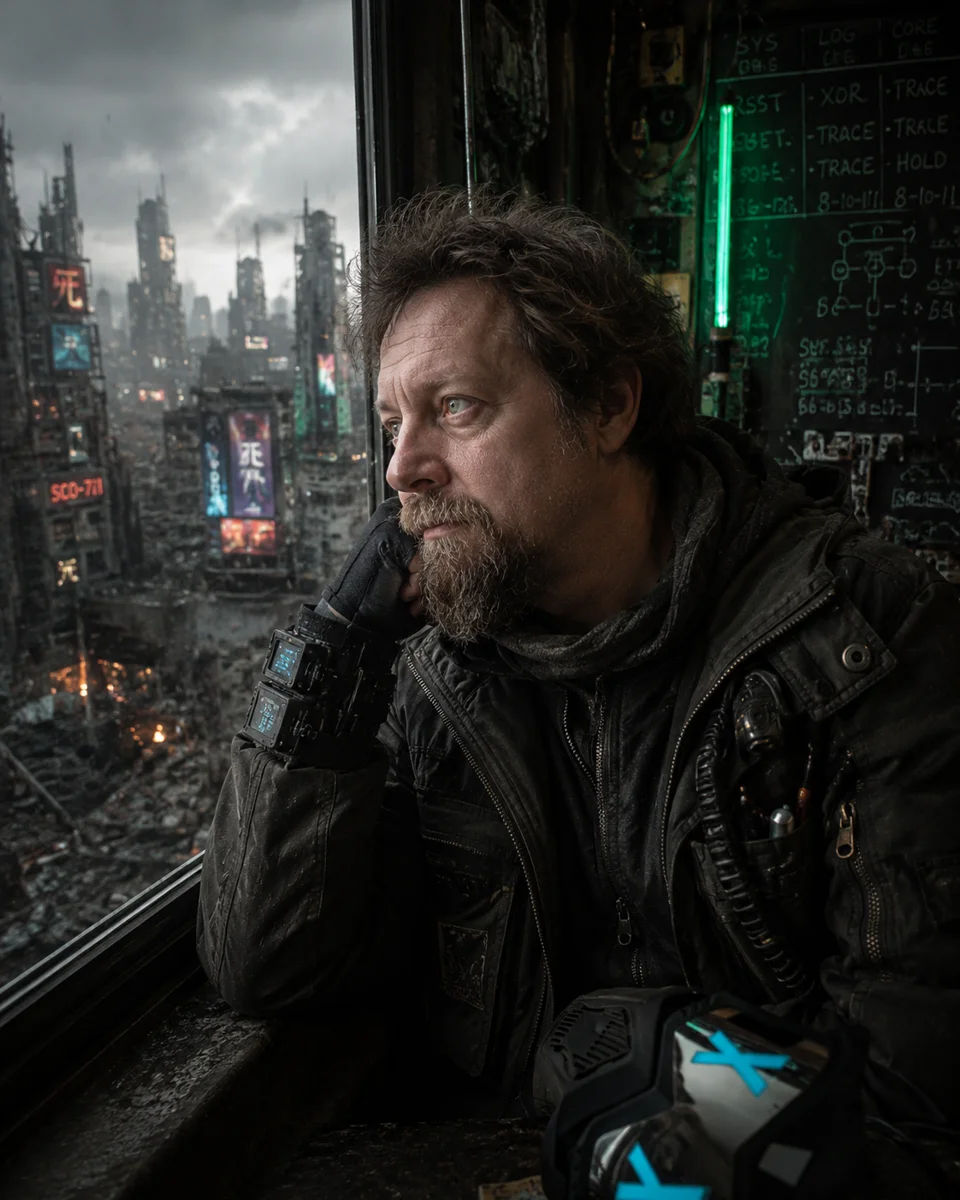
Not much light gets into the workshop. What there is comes in sideways, from a sign someone left on across the street, and settles on the tools like a coat of paint. It's in that moment — old iron, new cable, a coloured light that shouldn't be there — that I understand what the aesthetic we're talking about really is. It's not a style you buy. It's what's left when the promised future doesn't show up, and you have to build it yourself out of the parts you've got.
What "cyberpunk" means
The term cyberpunk comes from two words stuck together: cyber, meaning technology — networks, computers, cybernetics — and punk, the rebellious, anti-establishment attitude. It's the name of a science fiction subgenre that took hold in the mid-1980s with authors like William Gibson[1] and Bruce Sterling, with Philip K. Dick[2] as its acknowledged forerunner. Over the years the word stopped referring only to books: today cyberpunk aesthetics means a very specific way of making an image, a space or an object look.
The formula that sums it all up is three English words that have become almost a motto for the genre: high tech, low life[3] — top-shelf technology, bottom-rung lives. A world where neural implants and artificial intelligences exist, but ordinary people live in overcrowded streets, in the rain, in the shadow of skyscrapers owned by a handful of corporations. The contrast is not a flaw in the aesthetic: it is the aesthetic.
The elements of cyberpunk aesthetics
There are a few recurring ingredients. You don't need them all at once, but two or three are enough for an image to read as "cyberpunk" at a glance:
- NEON IN THE DARK — saturated artificial light (pink, cyan, purple, acid green) against dark, wet backdrops. The rain serves one purpose: multiplying the reflections. It's the most immediate and most imitated visual element of the genre.
- THE VERTICAL MEGALOPOLIS — enormous skyscrapers choking narrow, teeming streets. Up high, the glossy corporate headquarters; down below, markets, cables, signs in several languages: the city as a layered, unequal organism.
- THE AUGMENTED BODY — cybernetic prosthetics, digital eyes, implants. The human being who modifies themself with technology, out of necessity or by choice, is a thematic pillar even before it's a visual one.
- POWER IN THE HANDS OF CORPORATIONS — not a state, but a few private companies controlling technology, information and daily life. It's the political backdrop that gives "low life" its meaning: down below there are no citizens, only customers. (Let's remember we're human beings before we're customers.)
- USED AND REPAIRED TECH — no spotless showroom surfaces. Cyberpunk loves the dented device, the exposed cable, hardware held together with tape and stubbornness. Technology is everywhere, but it's dirty, old, jury-rigged.
- "RAW" TYPOGRAPHY AND INTERFACES — green-character terminals, glitches, dot-matrix fonts, flickering screens. An idea of the digital that's still angular, not smoothed over by contemporary design.
The last point is the one I feel is most mine, and also the most misunderstood: cyberpunk's decay isn't sloppiness, it's memory. Every object carries the marks of whoever opened it, fixed it, adapted it. In a world where everything is disposable, keeping a machine alive is already a small act of rebellion — the "punk" inside the "cyber".
Cyberpunk, steampunk, solarpunk: the differences
It's one of the most frequent questions, because the three names share the "-punk" suffix but tell opposite stories about the future. In short:
- CYBERPUNK — a near and dystopian future. Aesthetic: neon, night, rain, metal and circuits. Tone: "the future has arrived, but not for everyone".
- STEAMPUNK — a future imagined from the past: the steam-powered nineteenth century, brass, gears, airships. A warm, mechanical aesthetic rather than a cold, digital one. Nostalgic and adventurous in tone rather than dystopian.
- SOLARPUNK — a bright and sustainable future: greenery, natural light, renewable energy, community. It's almost the optimistic answer to cyberpunk: the same attention to technology, but in the service of life instead of against it.
Put bluntly: if cyberpunk asks "what if technology crushed us?", solarpunk answers "what if it saved us instead?", while steampunk changes the era altogether and imagines it running on steam. Three different answers to the same question about what our relationship with machines will be.
Why bare essentials are a choice here, not a pose
Now to the point that concerns this project. It's easy to reduce cyberpunk to a photo filter: stick in a couple of neon lights, add some fake rain, done. But the aesthetic I care about is the one that comes from a constraint, not from a graphic theme. Building a machine that has to run on very little power, with parts that are easy to find and repair, with nothing superfluous, leads to a look that resembles cyberpunk without chasing it: exposed cables because they need to stay accessible, cheap hardware because it's replaceable, spartan interfaces because they draw less power.
It's the flip side of consumer aesthetics, where the object is sealed, smooth and impossible to open. Here, bare essentials aren't showcase minimalism: they're a technical consequence. And when form comes out of function — instead of being glued on top of it — the result lasts, can be repaired, and almost by accident ends up telling the same story as those novels: high technology in hands that have to make do.
> formula: HIGH TECH + LOW LIFE
> palette: neon on wet darkness
> place: vertical megalopolis, corporations in power
> material: used, opened, repaired technology
> here: THE LOOK COMES FROM THE CONSTRAINT, NOT THE THEME
Frequently asked questions
What exactly does "cyberpunk" mean?
It's the combination of cyber (technology, networks, cybernetics) and punk (anti-establishment rebellion). It names a science fiction subgenre, born in the 1980s, set in a near-future dystopia where extremely advanced technology and social decay coexist. By extension, "cyberpunk aesthetics" refers to the visual style that comes out of it.
What elements make an image "cyberpunk"?
The recurring ones are: saturated neon lights in dark, rainy settings, vertical megalopolises with skyscrapers and crowded streets, power concentrated in big corporations, human bodies modified with cybernetic prosthetics, and technology that's used and repaired rather than new and polished. Two or three together are enough for the image to be recognised as cyberpunk.
What's the difference between cyberpunk and steampunk?
Cyberpunk imagines a near, dystopian digital future (neon, circuits, night). Steampunk imagines the future through nineteenth-century steam technology: brass, gears, airships, a mechanical, warm aesthetic rather than an electronic, cold one. They differ in reference era, materials and tone.
Are cyberpunk and solarpunk the same thing?
No, they're almost opposites. Cyberpunk is dystopian and dark; solarpunk is optimistic and bright, imagining a sustainable future made of renewable energy, greenery and community. They share an interest in technology, but cyberpunk fears it and solarpunk puts it in the service of life.
Is cyberpunk just the video game Cyberpunk 2077?
No. Cyberpunk 2077 is just the best-known work of the moment, but the genre has been around for decades: it started in literature (Gibson, Sterling, Dick) and runs through films like Blade Runner and Akira, the tabletop role-playing game Cyberpunk that the video game is based on, and countless comics and anime. The video game is a doorway, not the whole room.
The neon across the street has gone out. In the workshop, the light from the tool I was working on is all that's left — and that's fine. The better future isn't the one that shines brightest: it's the one that still lets you open it up.
Notes
- William Gibson — with Neuromancer (1984) he set the imagery and vocabulary of the genre: cyberspace, console cowboys, corporate megalopolises. It's the novel that gave cyberpunk half its aesthetic. ↑ back to text
- Philip K. Dick — forerunner of the genre; his novel Do Androids Dream of Electric Sheep? (1968) inspired the film Blade Runner (1982), a visual landmark of cyberpunk. ↑ back to text
- High tech, low life — the phrase used as shorthand for cyberpunk's thematic core: advanced technological progress coexisting with social decay and inequality. ↑ back to text