 SURVIVAL APPS
"Zoltar: Design and Schematics Before I Get My Hands Dirty"
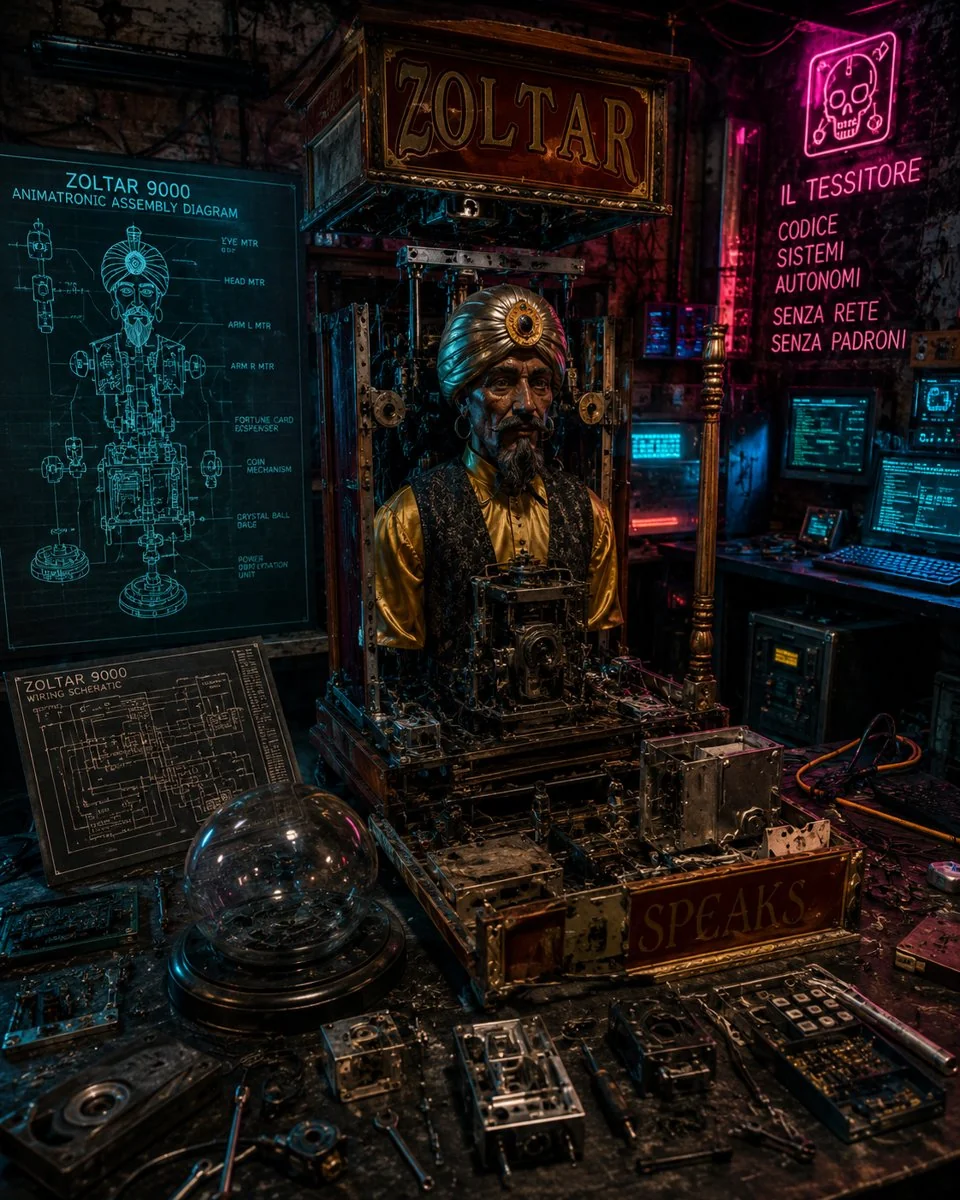
Before I solder a single wire, I draw. The old world was full of machines built in a hurry, without a schematic, that nobody knew how to repair once they stopped. I do the opposite: the machine exists on paper first, so that anyone who opens it — even me, ten years from now, with a shot memory — can understand how it breathes. Today Zoltar stopped being an idea. It has a diagram.
Where we pick up
In the first installment Zoltar was a hunch: a decommissioned aquarium to turn into a cyberpunk oracle. There was a case, a salvaged motor, and two decisions explicitly left hanging — the brain, and the way the machine delivers its verdict. This installment settles the first, half-opens the second, and changes a choice I had taken for granted. That's the beauty of designing on paper: you can change your mind without wasting solder.
The rethink: from Arduino to Raspberry Pi
In the concept I named Arduino as the brain, for philosophical consistency: cheap, repairable, no operating system to manage. Once I started designing in earnest, though, one constraint tipped the scales: I want the verdict to be printed, and the machine has to draw its phrases from an archive that can grow over time — maybe not just draw from it. Driving a printer and managing an evolving text archive is small-computer territory, not microcontroller territory.
So the brain will be a Raspberry Pi[1]. The switch isn't free, and it's only fair to state the price:
- WHAT I GAIN — a real filesystem for the archive of verdicts, ready-made printer drivers, and Python on board: the same language I work with by day, now back in service of a physical machine
- WHAT I PAY — higher power draw, a boot time (the Pi "boots", Arduino doesn't), and above all the need for a clean shutdown: cutting power to a Pi while it's writing to the SD card can corrupt it
That last point is a real design problem, not a detail: an oracle that gets switched on and off by yanking the plug would break itself within weeks. It will get its own installment on power — for now it stays marked in red on the diagram.
The verdict: a thermal printer
The movie Zoltar hands you a little card. The post-collapse version will use a thermal printer[2] — the kind that prints receipts: no ink, no toner, just a roll of paper that reacts to heat. It's the choice most faithful to the spirit of the original and, not by chance, also the most consistent with Zone 3: simple, repairable technology that produces a physical object the user carries away. A verdict that lives only on a screen gets forgotten; a verdict you hold in your hand doesn't.
Here too, the uncomfortable sides need saying before I fall in love with the idea:
- CONSUMABLES — the paper runs out. In a grid-down scenario that's a limit, but the rolls are small, cheap, and last a long time with occasional use
- MECHANICAL PARTS — a printer has gears and a cutter: it can jam. It's the most "alive" part of the machine, and therefore the most prone to breaking
- CURRENT SPIKE — the instant it prints, a thermal printer draws far more current than the rest of the machine. It has to be powered accordingly, or the Pi will reboot every time the oracle opens its mouth
The decision still open: how you consult it
How do you wake the oracle? I'm leaving this one deliberately open, because it's not (only) a technical choice: it's a choice of meaning. Three roads on the table:
| Option | Pros | Cons | What it says about the machine |
|---|---|---|---|
| Physical button | Dead simple to wire, sturdy, clear gesture | Not very theatrical | "Consult me whenever you like": an oracle within reach |
| Presence sensor | The machine reacts on its own to whoever approaches, a "living" effect | False triggers, wasted paper, needs anti-abuse rules | "I heard you coming": an oracle that waits |
| Real coin slot | Maximum fidelity to the original funfair machine | Complex, and out of tune with a world where money may be worth nothing | "Nothing is free": a mercenary oracle |
Today my inclination is toward the button for the first version — get the machine working in the simplest way, and add the sensor later if at all. But I'm not locking it in: the decision should be made once the case is assembled and I can see where the hand of the person consulting it naturally lands. Form follows use, not the other way around.
The block diagram
Put it all together and the rough layout of the first version looks like this: an input (the trigger, to be defined), a brain that decides and picks the verdict, and two physical outputs — the printed paper and the case animation (light and movement, from the previous installment).
[ ATTIVAZIONE ] --> ( RASPBERRY PI ) --+--> [ STAMPANTE TERMICA ] → responso su carta
pulsante? archivio frasi |
sensore? + logica +--> [ TECA ] → luce + movimento
> brain: raspberry pi (was: arduino)
> verdict output: thermal printer — OK
> trigger: OPEN DECISION
> critical node: clean shutdown + print current spike
And the phrases, where do they come from?
An oracle is only as good as what it says. The verdicts will live in a text archive on the Pi — easy to read, to fix, to grow. Whether the phrases will simply be drawn from that archive, or written by something else I've learned to keep at home in my systems, is a question the oracle would rather not answer for now.
Frequently asked questions
Why did Zoltar's brain move from Arduino to Raspberry Pi?
Because the project needs a real filesystem for the archive of verdicts (which has to be able to grow over time) and drivers to run a printer: jobs for a small computer, not a microcontroller.
How does the Zoltar machine deliver its verdict?
With a thermal printer, like the ones used for receipts: no ink or toner, just a roll of paper that reacts to heat — the choice most faithful to the spirit of the original oracle from the movie Big.
What's the critical point still to be solved in the project?
A clean shutdown of the Raspberry Pi (so the SD card doesn't get corrupted) and power delivery during the printer's current spike: the two nodes that will be tackled first in the electrical phase.
The schematic is pinned to the wall of the workshop, above the bench. It's not a machine yet — it's the promise of a machine, written in a language even tomorrow's me will be able to read back. This is where the real building starts.
Notes
- Raspberry Pi — a low-cost single-board computer running an operating system (usually Linux) from an SD card. Unlike a microcontroller such as Arduino, it runs complex programs and handles files and USB peripherals, but it needs an orderly startup and shutdown. ↑ back to text
- Thermal printer — prints by selectively heating treated paper, with no ink. It's the technology behind receipts and old fax machines. Hobbyist modules are driven over serial or USB and are widely documented. ↑ back to text
- Block diagram — a schematic representation of a system as a set of functional blocks connected by arrows, showing what each part does and how they exchange signals, before getting down to the detail of individual components. ↑ back to text