 SURVIVAL APPS
Zoltar: the Idea of a Cyberpunk Oracle Born from a Recycled Aquarium
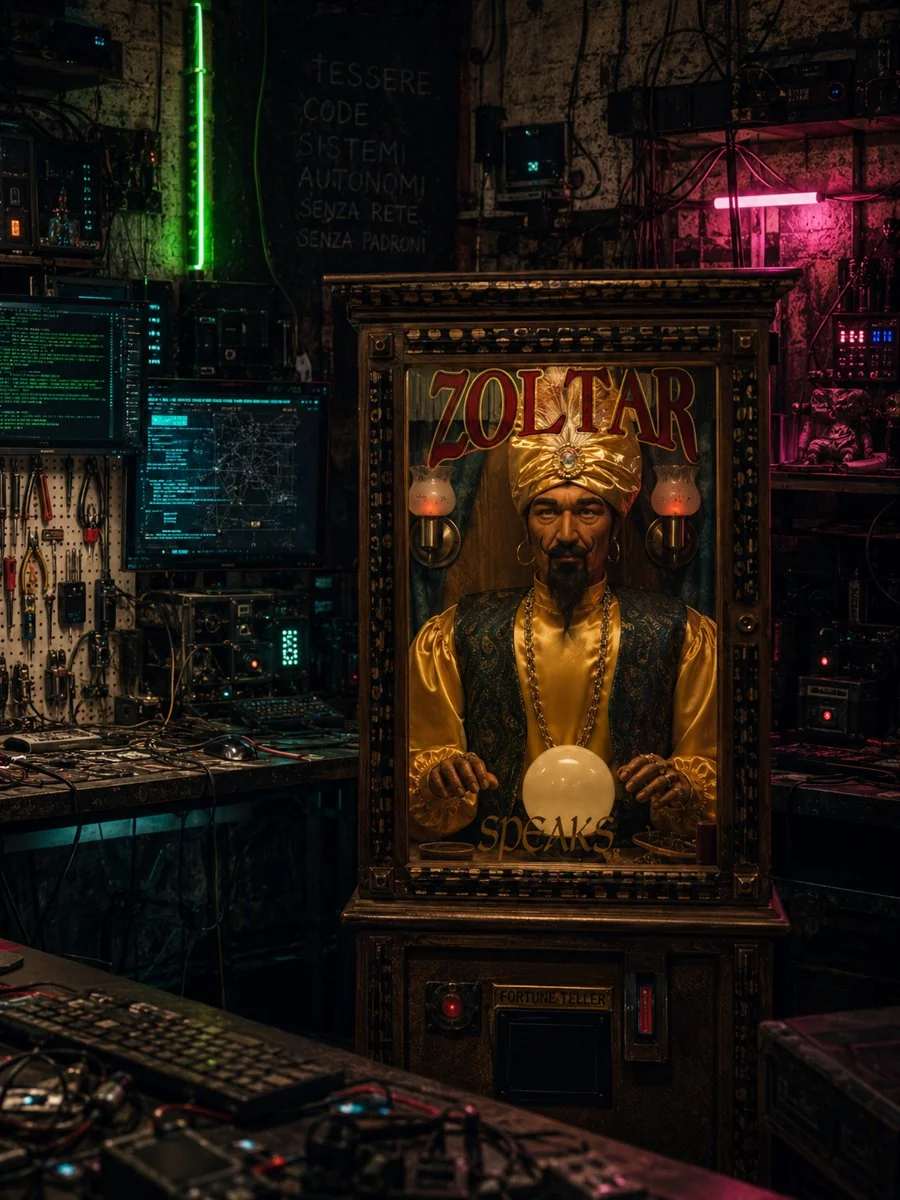
An aquarium hasn't pumped water in years. But the motor doesn't know that: it keeps turning for something else. I found it like that, in a corner, with the pump still healthy and the glass thick with dust — a small relic of the old world waiting for someone who could read it. I don't build from nothing. I listen to what a part still wants to do, and I let it do it somewhere else.
Where the idea comes from
Zoltar is the fortune-telling machine from the film Big (1988)[1]: the mechanical bust in a glass case that, for a coin, hands you a verdict on a little card. It's one of the most recognizable objects in the carnival imagination — and as it happens, I already had a glass case: a decommissioned aquarium, complete with pump, lighting and lid.
The idea is easy to state and long to carry out: turn that aquarium into a cyberpunk oracle. Not a nostalgic replica of Zoltar, but its post-collapse reincarnation: a salvaged case, exposed electronics, neon light filtering through the glass, and a verdict that arrives when you question the machine.
What's already on the bench
The project's starting point is the inventory of the wreck. Every component has a previous history, and almost all of them can have a second life with a function different from the one they were born for:
- THE TANK — clear glass, already watertight: it becomes the oracle's case, the machine's scenic "body"
- THE PUMP — the motor still works: a natural candidate for giving physical movement to something inside the case (a rotating element, a mechanical effect)
- THE LIGHTING — the old light fixture lends itself to being replaced or joined by addressable LEDs, for the oracle's glowing "breath"
- THE LID — already shaped to fit the tank: a perfect base for housing electronics and wiring without heavy machining
The brain: Arduino, by choice
The electronics will revolve around Arduino[2]. Not because it's the most powerful option — it isn't — but because it's the one most consistent with the philosophy of the project: cheap components, endless documentation, and an ecosystem you repair with a soldering iron instead of a support ticket. A post-apocalyptic oracle that depends on a cloud service would be a contradiction in terms.
How it's meant to work, in its first version: the user presses a button (the "coin"), the case comes alive — light, movement, maybe sound — and the machine delivers a verdict drawn from an archive of phrases. How the verdict gets delivered (display, printout, something else) is one of the open decisions, and deserves a post of its own.
> teca: aquarium tank, salvaged — OK
> motore: aquarium pump, working — OK
> cervello: arduino — model to be decided
> responso: output mechanism — OPEN DECISION
> stato: CONCEPT
Frequently asked questions
What is the Zoltar project?
A cyberpunk mechanical-electronic oracle, inspired by the fortune-telling machine from the film Big (1988), built by salvaging the parts of a decommissioned aquarium: tank, pump and lid repurposed as case and mechanics.
What microcontroller does Zoltar use?
Arduino: not the most powerful available, but the most consistent with the philosophy of the project — cheap components, broad documentation, repairable with a soldering iron instead of a support ticket.
How far along is the Zoltar project?
This transmission is episode zero (concept). Next comes the design and schematics, then the hunt for parts, the first electronic connections, assembly and the reveal of the machine at work.
The old world left behind more tools than we need to build a new one. You just have to know how to read them. This aquarium, for instance, never stopped being a display case: it was only waiting for an oracle to keep.
Notes
- Zoltar — the fortune-telling machine that grants the protagonist's wish in Penny Marshall's film Big. A cinematic descendant of the real fortune teller machines found at early-twentieth-century carnivals. ↑ back to text
- Arduino — an open-source platform of microcontroller boards, designed for electronics prototyping. Programmable in C/C++ through a free IDE; low cost and a huge community. ↑ back to text
- The Artificer of the Ruins — the second narrative figure of this blog, counterpart to the Weaver: signs the posts dedicated to hardware, salvage and physical builds. ↑ back to text